
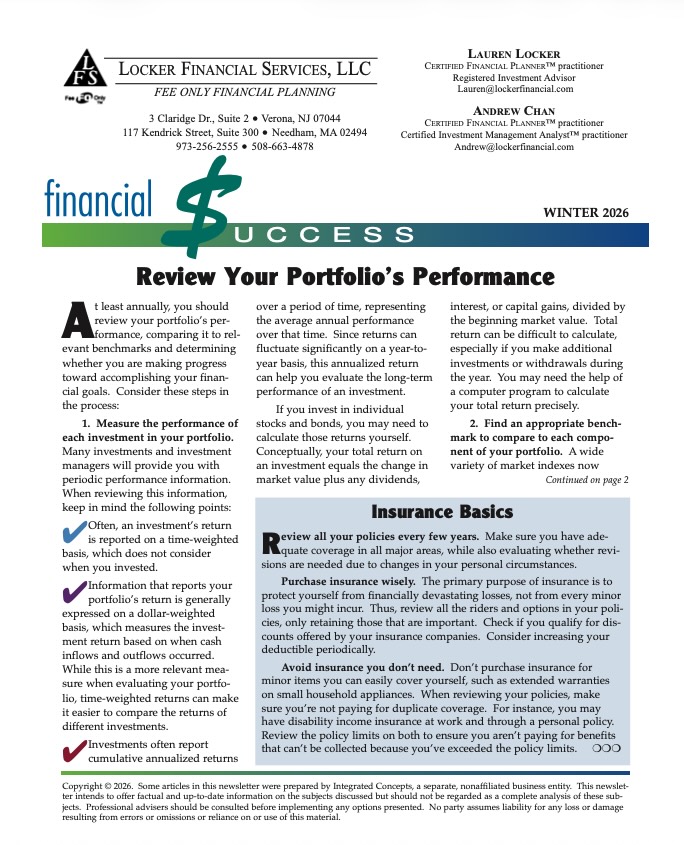
At least once a year, you should sit down with your portfolio and take an honest look at how your investments are performing. For investors, this kind of annual review is one of the most practical steps you can take toward reaching your financial goals.
Measuring What Your Investments Are Actually Doing
Look at Each Investment Individually
When reviewing your portfolio, start by assessing each investment on its own. Your investment manager or financial advisor will typically provide you with periodic performance reports — but it helps to understand what those numbers are actually telling you.
One important distinction to be aware of is how returns are calculated. Investment returns are often reported on a time-weighted basis, which measures performance relative to when you first invested. This method does not account for the timing of additional deposits or withdrawals. A dollar-weighted return, on the other hand, measures the investment return based on actual cash flows in and out of the account. This figure tends to be more relevant when evaluating your personal portfolio because it reflects the real-world impact of your contributions and withdrawals over time.
It is also worth noting that investment reports often show cumulative annualized returns. These figures represent the average annual return over a set period of time and can be a useful way to evaluate the long-term performance of a given investment.
Calculating Total Return
If you hold individual stocks or bonds, calculating your total return means accounting for dividends, interest, and any change in market value. Put simply, total return equals the change in market value plus any dividends, interest, or capital gains — divided by the beginning market value.
This calculation can get complicated if you made additional contributions or took withdrawals during the year. In those cases, a financial planning tool or professional may be needed to arrive at an accurate figure.
Finding the Right Benchmark
Once you have a sense of how each investment has performed, the next step is putting that performance in context. A benchmark allows you to compare your returns against a relevant market index. There are a wide range of market indexes available today, and choosing one that closely mirrors the composition of your portfolio will give you a more meaningful comparison.
Understanding Insurance: Covering What Matters
Review Your Policies Regularly
Insurance is a fundamental part of any sound financial plan, you should make a point of reviewing all their policies every few years. During that review, confirm that you have adequate coverage across major areas of your financial life. As your circumstances change, your coverage needs may shift as well.
When reviewing policies, look closely at all the riders and options attached to them. Retain the features that serve a real purpose and consider removing coverage you no longer need. It is also worth comparing what different insurance companies offer, as premiums and options can vary.
Buy What You Need — Not More
One of the more practical principles of sound insurance planning is avoiding coverage for things you could realistically cover on your own. Extended warranties on household appliances, duplicate coverage across multiple policies, and benefits you are unlikely to collect can quietly add cost without adding protection.
Review your policies carefully to make sure you are not paying for duplicate coverage. For instance, disability income insurance may be available both through your employer and through a separate personal policy. Understanding what each provides will help you avoid paying twice for the same protection.
Similarly, take time to look at any policy limits and benefit caps. Some policies include provisions that limit or exclude benefits once a certain threshold is reached. Understanding these terms helps avoid surprises when coverage is needed most.
Consider Your Deductibles
Adjusting your deductibles is one straightforward way to manage the cost of your insurance coverage. Higher deductibles typically reduce your premium, which may make sense if you have sufficient savings to cover out-of-pocket costs in the event of a claim. A fee-only financial planner can help you evaluate what deductible levels are appropriate given your overall financial picture.
Working With a Fee-Only Financial Planner
Locker Financial Services, LLC is a fee-only financial planning firm serving clients around the country, including New Jersey and Massachusetts. As fee-only advisors, Lauren Locker and Andrew Chan do not earn commissions — their compensation comes directly from clients, which means their guidance is not influenced by product sales.
Both Lauren Locker, CFP, and Andrew Chan, CFP, CIMA, bring professional credentials and a commitment to helping individual investors in New Jersey make confident, informed financial decisions.
If you would like help with your financial planning and investment needs, contact Locker Financial Services to schedule a consultation.
Call 973-256-2555 or Contact Us To Speak With A Fee-Only Financial Planner
Some articles in this newsletter were prepared by Integrated Concepts, a separate, nonaffiliated business entity. This newsletter intends to offer factual and up-to-date information on the aspects discussed, but should not be regarded as complete or accurate. Professional advisors should be consulted before implementing any options presented. No party assumes liability for any loss or damage resulting from errors, omissions, or reliance or use of this material.